
For Toy Resellers

Toy Inventory Software for Collectible Sellers

In collectible toys the packaging is frequently worth more than the toy, and a single missing accessory can halve the value of an otherwise perfect figure.

✓ Boxed and loose✓ Accessory checklists✓ Packaging condition

THE SHAPE OF THE PROBLEM

The box is not packaging. It is part of the product.

Collectible toys invert the usual instinct that the item matters and the container does not. A mint-in-box figure and the same figure loose are different products at different prices to different buyers, and among boxed examples the difference between a crisp box and a shelf-worn one with a creased window is often substantial.

Instica keeps the packaging state and the accessory inventory on the record, alongside cost and condition. That means the decision that actually matters for a boxed piece — whether to keep it sealed or open it and sell the figure loose with its accessories — is made against recorded facts rather than a hazy memory of what the box looked like.

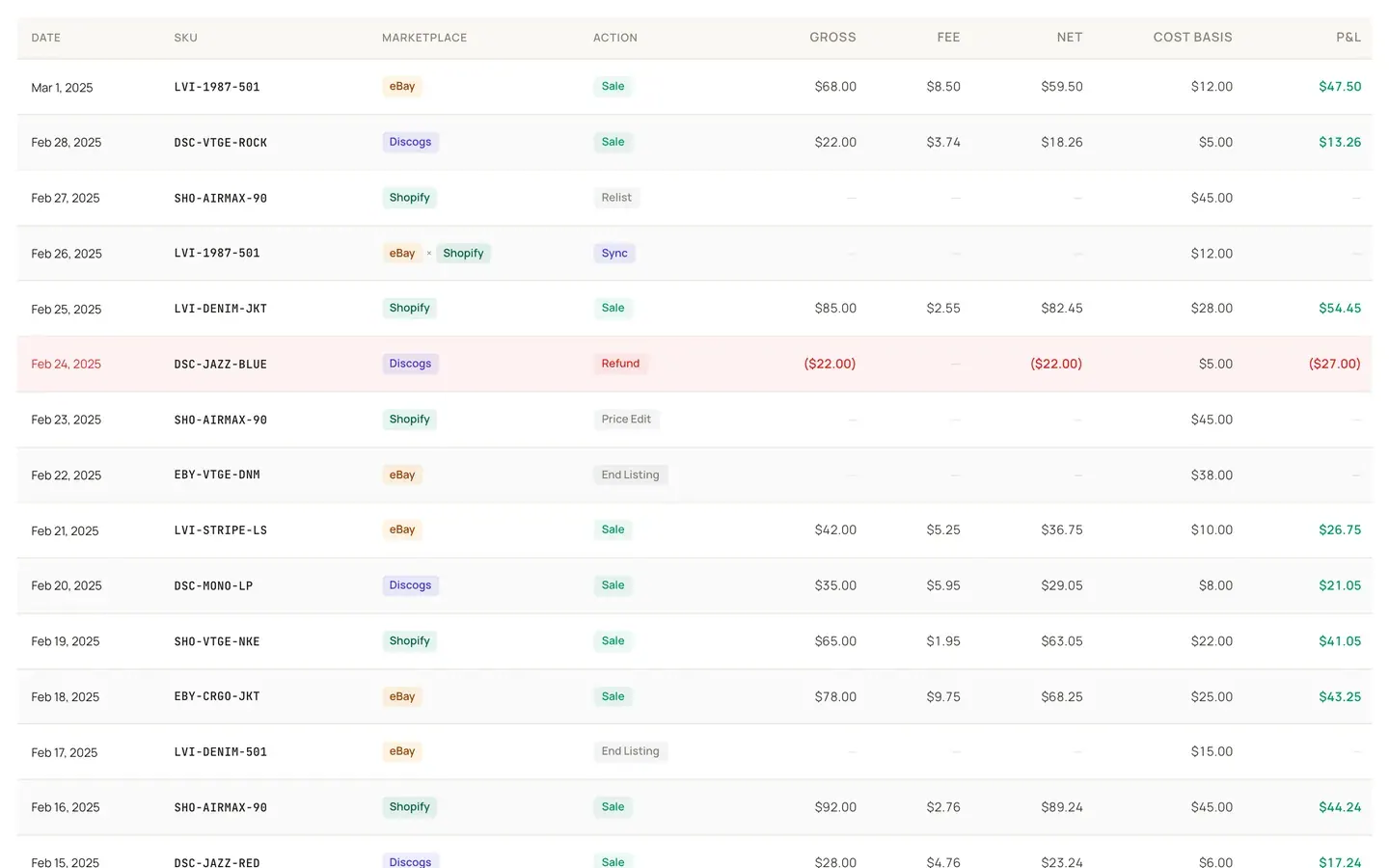
Instica ledger export showing sold rows with cost, gross, fees and net columns
Sealed and opened stock settle differently. The ledger keeps them apart because packaging state was recorded at intake.

WHAT THE RECORD HOLDS

Three things worth getting right

Packaging state, recorded specifically

Sealed, opened but complete, box only, no box. Beyond that, the specific damage: crushed corners, a yellowed window, a price sticker that will tear the card. These are the details boxed-toy buyers ask about before every purchase.

Accessories as a checklist

Weapons, stands, swappable hands, instruction sheets, collector cards. A loose figure is priced by what it comes with, so the accessory list belongs on the record where it can be checked before listing rather than after a question arrives.

Line and wave identity

Toy lines re-release the same character repeatedly across waves and exclusives that differ in small, valuable ways. Holding the line and wave as fields prevents a chase variant from being sold as the common release.

THE WORKFLOW

Processing a mixed toy haul

Toys arrive from estate buys, storage lots and collection sales, usually as a mixture of boxed pieces and a bag of loose figures with the accessories scattered through it.

  1. 01

    Separate boxed from loose immediately

    These are two different workflows. Boxed pieces need careful handling and packaging assessment; loose figures need matching against accessory lists, which is a slower and more fiddly job.

  2. 02

    Reunite accessories before cataloguing

    Do the sorting pass across the whole haul first. A stand matched to the right figure can add real value, and once figures are catalogued and boxed for storage the loose parts never get reunited.

  3. 03

    Photograph packaging flaws under real light

    Creases, shelf wear and yellowing are hard to see in a quick photo and impossible to dispute later if you did not capture them. This is the evidence that protects a boxed sale.

  4. 04

    Decide sealed or opened, then record it

    Opening a sealed piece is irreversible and changes what you own. Recording the decision and the reasoning on the record keeps your inventory honest about what is actually on the shelf.

CHANNEL BY CHANNEL

What each connected channel offers a toy inventory

Instica connects to eBay, Shopify and Discogs. Two of those are useful here; the third is not, and pretending otherwise would waste your setup time.

eBay
Deepest buyer pool for both boxed and loose collectibles. eBay sends sale notifications to Instica by webhook, so a sold piece is marked on the record and your other listings follow from it.
Shopify
A good fit for sellers with a recognised specialism in a particular line who want a shop of their own. Instica pushes products and quantities out; it does not read Shopify orders back, so you mark storefront sales sold yourself.
Discogs
A catalogue for music releases. It does not list toys, and connecting it will not do anything for this inventory.

WHERE IT GOES WRONG

Where toy resellers lose money

Selling a figure with an accessory still in the bin

The missing piece is often what the buyer wanted, and the complaint arrives after the sale. Working from an accessory checklist at packing time is a thirty-second habit that prevents most of these.

Understating packaging wear

Boxed-piece buyers are buying the box as much as the contents, and they inspect it closely on arrival. A "mint in box" description on a shelf-worn example generates the return, and shipping a boxed toy twice erases the margin.

Storing boxed stock badly

Sunlight yellows windows and stacking crushes corners, so inventory can lose value while sitting still. Recording intake dates makes long-held boxed stock visible enough to check on rather than forget about.

FREQUENTLY ASKED

Questions toy resellers ask

Should a loose figure and a boxed one be separate records?

Yes, always. They are different products with different buyers and different prices. Merging them into one record with a quantity destroys exactly the distinction that determines what each is worth.

How do I keep track of which accessories a figure came with?

Record the accessory list on the item at intake, while everything is spread out in front of you. It becomes the packing checklist later, which is where the value of having written it down actually shows up.

Can I record the same toy line across multiple waves?

Yes. Line and wave live as fields on the record, so near-identical releases stay distinguishable in your own inventory rather than collapsing into one ambiguous entry.

From the reselling course

Reading for stock where the box is the product

In collectible toys the packaging routinely carries more value than the figure inside it, and one missing accessory halves the price. The order below reflects that: value, then verification, then everything that protects the box.

  1. 01
    Valuing Inventory Before You Buy It

    Loose, complete, boxed — three prices for one item, and the difference is decided before you buy.

  2. 02
    Authentication and Counterfeit Risk

    Reproduction accessories and resealed boxes, and how to spot both.

  3. 03
    Grading and Describing Condition

    Describing a crease, a price sticker or a missing weapon so it never becomes a return.

  4. 04
    Packing Fragile and High-Value Items

    Shipping a box inside a box, which is the only way this stock arrives intact.

  5. 05
    Fraud, Scams, and Payment Risk

    Empty-box and swapped-figure claims, and the photographs that end them.

  6. 06
    Insurance and Business Risk

    What a shelf of boxed figures is worth to an insurer, as opposed to what it is worth to you.

Free, in any order — the complete course. Or start with the three-minute reseller diagnostic.

Start with 25 items. Stay for 25,000.

Free for 25 items · No card · Cancel from your account page.

También disponible en españolEspañol →
Disponível em portuguêsPortuguês →
Auf Deutsch verfügbarDeutsch →
Disponible en françaisFrançais →
中文版本可用中文 →